

Magnetic flow meters
Flow meters
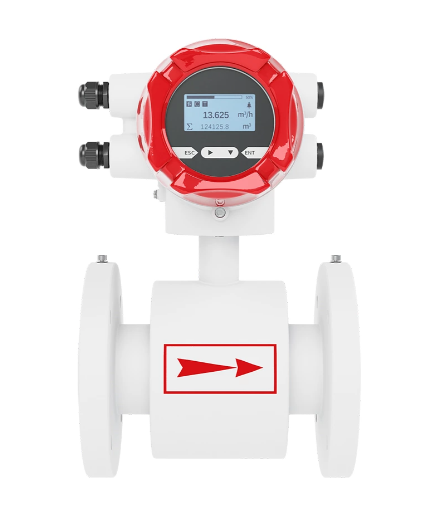
Magnetic flow meters for conductive fluids
Electromagnetic induction instruments for the accurate measurement of water, chemical solutions and industrial fluids. Available from DN 3 to DN 2000, with IP67/IP68 protection and support for all major fieldbus protocols.
No moving parts
DN 3 – DN 2000
IP67 / IP68
HART · PROFIBUS · Modbus
Oil & Gas · Chemical · HVAC
How it works
The meter is based on the principle of electromagnetic induction (Faraday’s law): a conductive fluid passing through the magnetic field generated by the instrument produces a voltage proportional to the flow velocity. No moving parts, no pressure drop, minimal maintenance. Ideal for aggressive or viscous fluids and for liquids carrying suspended solids.
Key benefits
Not sure whether a magnetic meter is the right technology for your process?
Main technical specifications
Nominal diameters
DN 3 – DN 2000
Nominal pressure
PN 10 – PN 100
Process temperature
up to 180 °C
Protection rating
IP67 / IP68
Process connections
Threaded · Flanged · Clamp
Transmitter
Integral / remote-mountable
Application sectors
Frequently asked questions
How does a magnetic flow meter work?
It works on the principle of electromagnetic induction (Faraday’s law): when a conductive fluid passes through a magnetic field, a voltage proportional to the flow velocity is generated. The on-board electronics convert that signal into a volumetric flow reading. There are no moving parts in contact with the fluid, which ensures a long service life and reduced maintenance.
Which fluids can be measured?
All conductive liquids, including water, chemical fluids and industrial solutions, even corrosive or abrasive ones, provided they fall within the conductivity limits stated by the manufacturer (generally ≥ 5 µS/cm). It is not suitable for non-conductive fluids such as pure hydrocarbons, gases or steam.
What is the difference between a magnetic meter and a Coriolis meter?
A magnetic meter measures volumetric flow and is ideal for conductive liquids at a contained cost. A Coriolis meter measures mass flow and density and works with almost any fluid, including non-conductive ones, but is more expensive. For water, chemical solutions or conductive process fluids, the magnetic meter is generally the best choice.
What accuracy can be expected, and what affects it?
Magnetic flow meters typically offer an accuracy of ±0.2–0.5% of reading. The actual accuracy depends on correct installation (straight runs upstream and downstream), selecting the DN appropriate to the flow rate, the conductivity of the fluid and the model chosen. Our technical team supports you in selection and correct sizing.
Does it work with non-conductive fluids?
No. The operating principle requires the fluid to have a minimum electrical conductivity (generally ≥ 5 µS/cm). For non-conductive fluids such as hydrocarbons, oil or gas, Coriolis, Vortex or ultrasonic meters are more suitable. Contact us for an analysis of your process.
Need help choosing?
Our technical team helps you identify the magnetic flow meter best suited to your process, with a tailored quotation and fast response times.
At G.M. Consulting S.a.s. you will find
Fast quotations, thanks to our long-established supplier database
Customised sourcing to find the right product for each client’s requirements
On-site service for start-up and maintenance
Request a quote
Our company operates across all manufacturing sectors, with a particular focus on Oil & Gas and Power. We support our clients as a solution provider for physical measurement instrumentation, process automation and mechanical components.
Operational headquarters
Via Panciatichi 92, 50127 Florence (FI), Italy
Email:
gianni.musso@gmconsultingsas.it
luca.musso@gmconsultingsas.it
Phone
+39 055 0516433